I was looking into some details about spot spraying pump arrangements and pressure management and realised this might be useful for others here working on similar builds.
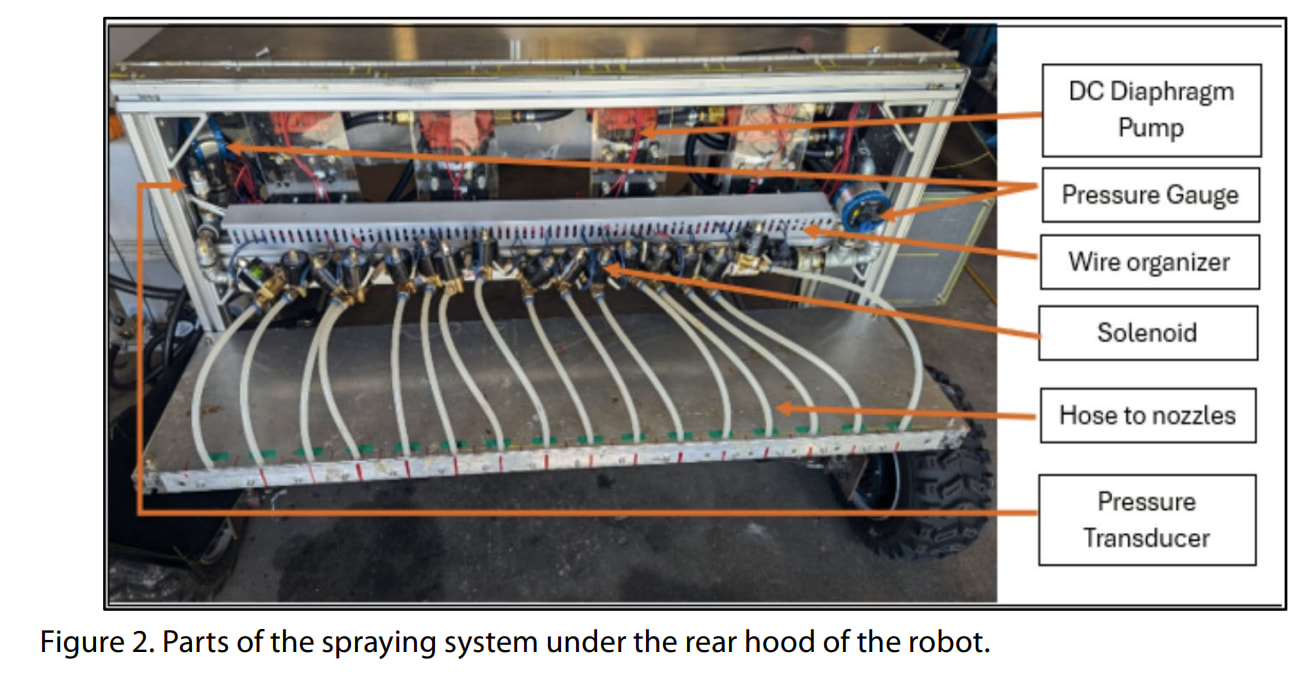
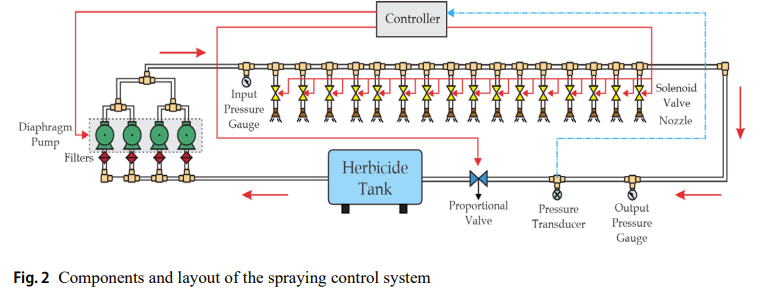
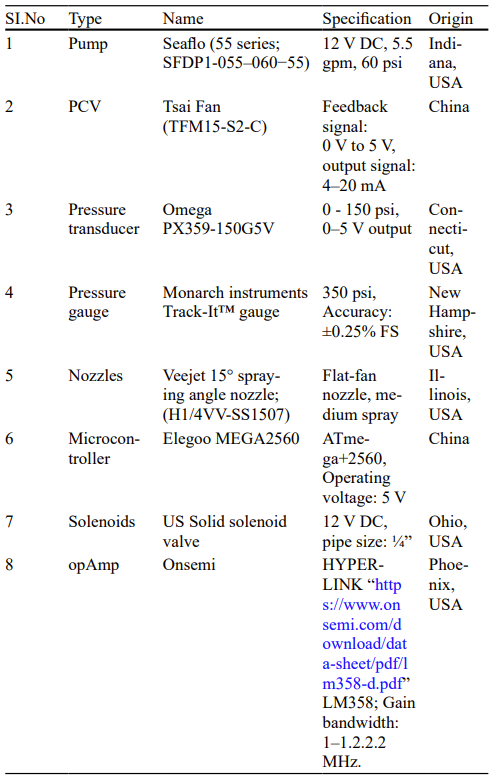
It is based on a detailed paper by Vinay Vijayakumar (University of Florida) on designing a smart sprayer. It provides a lot of detail on the layout of the control system, and how to maintain constant pressure across the 16 nozzles using 4 Seaflo pumps.
One aspect that caught my eye was that instead of running a single pump, they used a parallel 4-pump system that works alongside a a proportional control valve on the return.
By using PID to manage the pump duty cycle and the pressure control valve opening, they get really stable pressure at each nozzle and even out the peaks when nozzles turn on and off rapidly.
It is on the complex side for a setup, but the settling time of 0.18s is decent if you are looking for high precision.
Instead of four pumps, there have been good results (and the industry standard I would say) with a simpler Ramsay valve included on a standard return flow system.
If anyone has other ideas - would love to hear them! Most systems we have built to date are narrow enough (<2m width) that this has been less essential to consider.
Thanks for the summary Guy. I can’t access the article. But my comment from what I read is I suppose I like this even though it’s got more components than a Ramsay valve because you don’t need air compressor or a large pump and it’s scalable from very small. I have a AU$90 version of that 12v pump on my quad that I bought off vevor and it works great for spraying around sheds.
My other thought is you say on smaller systems you have not had to worry so much about this sort of thing. Why not run 6x 2m systems in a 12m boom? My first though is wear and tear on have 6 pumps always running, plus power drawn when this more complicated system would mean most of the time 1 to 2 pumps is sufficient.
Ah sorry about that - this link should hopefully work. Slightly different paper, but same machine. Long story short was they found that 4 pumps is better than 1 for pressure management and reducing workload on the single pump.
That’s a good point on modularity and pump size. We’ve used smaller but similar style pumps (8.3LPM) for our 2m ute-mounted system. If all 8 nozzles were on though there was a noticeable pressure drop.
I would say a recirc boom is fairly essential, but adding more pumps could make sense, particularly if you added them closer to each section to reduce pressure loss and improve system responsiveness. That would multiply out your pressure regulation/sensors though.
I had a thought. What if you just use more volume to compensate. I’m planning a 10m setup, with 9 owl units. I will be using 20 inch spacing, so 18 nozzles. Instead of 1/4” solenoids and lines, how about 3/8” with a 1/2” circulating supply line? You could still use the proportional control valve on return.