No problems at all - always happy to answer things here. Will be exciting to see how your setup is coming along.
As pre-text to these responses, they just represent where we’re currently thinking and nothing is really set in stone (though this version has be CE tested now, so some changes are a little more challenging). Always open to suggestions/feedback on the approach.
- Will the unit be based on pi 5 or jetson or customers choice?
Everything will be based on the CM5 and more specifically probably the 2GB RAM, 16GB EMMC with (SC1588) or without wifi (SC1558). RAM prices have made us ration it as low as possible, hence the recent RAM Shortages - will 2GB be fine?. But I don’t really think this will affect anything unless you’re running massive AI models. Which brings me to Q2:
- Is the pi 5 powerful enough to run models stay cool in a hot environment?
Yes and no to both parts of that question! I have run YOLO26 Nano object detection models at up to 20 to 30 FPS on the Pi alone - albeit overclocked and on my desk. In this VegetablesWA project we’re running YOLO segmentation models at around 12 FPS (water cooled) on the Pi 5 with no added help. So yes it is possible and considerably cheaper, but not optimised and on the slow side.
Instead, like Sébastien has done with his onion system, we’ll move to support the Hailo 8 chip, but integrated into the board. They cost about USD120 each though, so we’ll just make it an option people can add. It does add a lot of longevity though as you say, and in the scheme of things isn’t so expensive.
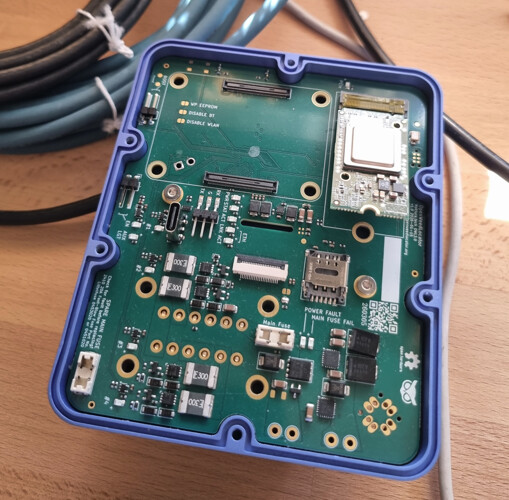
The Hailo chip is in the top right using the M.2 slot. The CM5 will go in the space next to it. The M.2 slot can be used for anything really, you can install an SSD there too if you wanted to.
Temperature wise, the models running on the Pi alone make it run hot. Water cooling has worked fantastically. Even in 43C under the black hood of the veggies system, they were staying a constant ~33C. But water and computers is not ideal, so the new versions are thermally connected to the alu enclosure and then the shield provides an air gap to keep the sun off the aluminium, while letting air move over the heatsink fins. The Hailo chip will also reduce heat production - it’s more efficient for the task.
- The way I see it the reason the go owl over weedit is it is potentially for much more flexibility in offering green on green and being a part of developing the tech. If processing power is only good enough for open cv type greenness or similar then weedit would be a better fit.
Agreed - even without the Hailo chip, you could still run models, but this new design leaves it more upgradeable for future chips.
- I see you have a communication protocol with a screen for a tractor. I think I’ll be running a web server on the rover, maybe a pi that I log into so it won’t be too hard the stream the owl dashboard though that. Any apis or ideas how this would work? Mobile starlinks have opened up many possibilities in this space, even uploading photos etc on the go.
The OWL currently just runs a web server and uses a set of MQTT commands for control/updates. It runs over the local network and uses a central pi to control everything. That could be your Pi that you put on the rover. The list of commands/topics are in the mqtt_manager.py file. We’re also building this into the https://noktura.tech platform, so you can remotely monitor/manage/share the OWL system. Just needs a router with a sim card.
- Where does your product stop? Eg will you supply units with a router linked and bench tested? Just the units?
We’ll have a couple of different options:
- just buy an OWL with the power cables/harness you need to get it going with/without the AI chip.
- sell kits in different widths/camera number. These would have the router, industrial switches, network cables etc needed. At this stage we aren’t doing custom cable lengths or re-designing it for every person, but rather just all the equipment you need to set up 12m for example, delivered.
We also won’t provide models (at least for now) - far too complex for us to try and build them for everyone and it’s the biggest barrier to market entry for all these spot spraying systems. But through the Noktura platform, we will make it as easy as possible to do it yourself. Green-on-Brown doesn’t need training, so that can be useful as a starting point for some.
Besides this, we will also sell the spares/mounts and the OWL driver board if you just want to stay with the Pi 5 HAT route too.
We are still figuring this out and hardware is very capital intensive from the start. So initially we’ll be reaching out to everyone who has got in touch with us and asking what their requirements are and then sending a quote through. Then based on pre-orders, we’ll then order the first batch of 100 units, build and then ship those. Anything under 100 OWL units is uneconomical for everyone involved - PCB and enclosure manufacture gets much cheaper with scale.
I already have you down Ben, but if anyone reading this wants to be on the emailing list for this first 100, then register your interest here. We want to work closely with whoever purchases this first batch to validate the design and fix things as they come up. It is limited in a sense we won’t do more than 100 for this first batch, but more batches will open after. First batch just has upsides in that we work more closely and you get access to it fast, and downsides in it being the first batch.
Eventually, the plan is to just have a webshop where you can purchase kits/owls/components as you would with any other online store.
Hopefully this helps describe our approach!